Sunday, June 30, 2013

Kerry pushing Israel, Palestinians to resume talks

JERUSALEM (AP) ? U.S. Secretary of State John Kerry, engaged in breakneck shuttle diplomacy to coax Israel and the Palestinians back into peace talks, is flying to the West Bank on Sunday to have a third meeting in as many days with Palestinian President Mahmoud Abbas.

U.S., Israeli and Palestinian officials have declined to disclose details of the past three days of closed-door meetings, but Kerry's decision to fly from Jerusalem to Ramallah, West Bank, to see Abbas again before he leaves the region was an indication that the secretary believes there is a chance of bringing the two sides together.

"Working hard" is all Kerry would say when a reporter asked him at a photo-op whether progress was being made.

Despite the lack of readouts, there are several clues that the meetings have been more than routine chats.

Most of Kerry's meetings have lasted at least two hours and several of them were much longer. His initial dinner meeting Thursday night with Netanyahu was clocked at four and the one Saturday night with the Israelis that started around 9 p.m. in a hotel suite was still going on at 2:30 a.m. Sunday.

Legal, military and other officials accompanied Netanyahu at the meeting, perhaps an indication that discussions had reached a more detailed level.

Kerry canceled a visit to Abu Dhabi on his two-week swing through Asia and the Mideast because of his extended discussions on the Mideast peace process in Jerusalem and Amman, Jordan.

And just the sheer number of meetings since Thursday ? three with Netanyahu and soon-to-be three with Abbas ? could indicate that the two sides are at least interested in trying to find a way back to the negotiating table.

A senior U.S. State Department official said Kerry would travel to Ramallah on Sunday to meet Abbas. The U.S. official was not authorized to discuss the negotiations by name and requested anonymity.

The meeting, however, will further squeeze Kerry's itinerary. He's scheduled to be at a Southeast Asia security conference on Monday and Tuesday in Brunei ? some 5,400 miles from Israel. On the sidelines of the conference, Kerry is to meet Russian Foreign Minister Sergey Lavrov in an exchange that likely will focus on National Security Agency leaker Edward Snowden. Kerry also is to have a trilateral discussion with Japanese and South Korean officials that likely will include the topic of North Korea's nuclear ambitions.

For now, however, Kerry has his head in the Middle East. Except for quick flights to meetings in Amman, Kerry mostly has been holed up on the upper floors of a hotel near Jerusalem's Old City engaged in deep, serious conversations about the decades-old conflict. On other floors, the hotel has been hosting large family gatherings, and noisy children in party clothes have been running up and down the hallways, oblivious to Kerry's presence.

There is deep skepticism that Kerry can get the two sides to agree on a two-state solution. It's something that has eluded presidents and diplomats for years. But the flurry of meetings has heightened expectations that the two sides can be persuaded to restart talks, which broke down in 2008, at the least.

So far, there have been no public signs that the two sides are narrowing their differences.

In the past, Abbas has said he won't negotiate unless Israel stops building settlements on war-won lands or accepts its 1967 lines ? before the capture of the West Bank, Gaza Strip and east Jerusalem in a Mideast war that year ? as a starting point for border talks. The Palestinians claim all three areas for their future state.

Netanyahu has rejected the Palestinian demands, saying there should be no pre-conditions for talks.

Abbas made significant progress with Netanyahu's predecessor, Ehud Olmert, in talks in 2007 and 2008, but believes there is little point in negotiating with the current Israeli leader.

Netanyahu has adopted much tougher starting positions than Olmert, refusing to recognize Israel's pre-1967 frontier as a baseline for border talks and saying east Jerusalem, the Palestinians' hoped-for capital, is off the table. Abbas and his aides suspect Netanyahu wants to resume talks for the sake of negotiating and creating a diplomatic shield for Israel, not in order to reach an agreement.

Abbas has much to lose domestically if he drops his demands that Netanyahu either freeze settlement building or recognize the 1967 frontier as a starting point before talks can resume. Netanyahu has rejected both demands. A majority of Palestinians, disappointed after 20 years of fruitless negotiations with Israel, opposes a return to talks on Netanyahu's terms.

While details of the ongoing discussions have remained closely held, it has not quelled speculation. Midday Saturday, news reports said a four-way meeting was going to be held in coming days with the U.S. Jordan, Israel and the Palestinians at the table.

"They're saying a four-way summit, did you hear that?" Netanyahu asked Kerry during a photo-op before his latest meeting with Kerry.

"I did," Kerry replied.

There is speculation that talks are going well and that they're headed nowhere.

Asked if the two sides were close to resuming negotiations, Israeli Cabinet Minister Gilad Erdan told Channel 2 TV: "Regrettably, so far, no."

___

Associated Press writer Karin Laub in Ramallah, West Bank, contributed to this report.

Source: http://news.yahoo.com/kerry-pushing-israel-palestinians-resume-talks-214829857.html

kate gosselin helicopter crash matt jones whitney houston in casket photo resolute national enquirer whitney houston casket photo jk rowling

Saturday, June 29, 2013

A Delhi Ohio woman who lost her wedding ring more than 40 years ago recently had it found by a neighbor who was cleaning up aft...

SbB LIVE FROM LA (Jun 29, 2013 @ 5:18am ET)

Comments | SbB Live RSS Feed
Friday, June 28, 2013

9:00 PM: Paralyzed football player Eric LeGrand shares video of himself getting pushed around by his therapy dog Willie.

8:45 PM: Mike Tyson tweeted on Friday: "16 yrs ago today I had the notorious Bite Fight with (Evander Holyfield). I'm so glad we are friends now."

8:30 PM: A former Tennessee Titans cheerleader accused of groping a 12-year-old boy refused a plea deal in court on Friday. Elizabeth "Leigh" Garner has a trial date set for November 12 on charges of aggravated sexual battery & solicitation of a minor for child rape.

8:15 PM: The Tennessean reports that four Vanderbilt football players have been suspended amid a sex crimes investigation by Nashville police.

8:00 PM: Former Louisville basketball player Peyton Siva said he got some "awkward looks" from Michigan fans while at Friday's press conference to introduce the Detroit Pistons' draft pick. The Cardinals defeated the Wolverines in this year's NCAA title game.

7:45 PM: New Jersey Devils goalie Martin Brodeur has been chosen to be the cover model for EA Sports' NHL 14 video game.

7:30 PM: The Columbus Blue Jackets announced Friday they have signed head coach Todd Richards to a one-year contract extension through the 2014-15 season.

7:15 PM: Doc Rivers explained Friday why he called Bill Simmons an "idiot" after the ESPN analyst said Rivers quit on the Celtics: "I thought it kind of ruined the broadcast last night, 'cause he kept bringing it up. It was almost like he had an agenda. I was just getting tired of it."

7:00 PM: From The Onion: "Stanley Cup Shot 11 Times During Chicago Blackhawks Victory Parade"

6:45 PM: Ray Allen will return to the Miami Heat next season after picking up his $3.2 million contract option.

6:30 PM: Milwaukee Brewers first baseman Corey Hart will be out for the rest of the season as he prepares to undergo surgery on his left knee. Hart has been on the disabled list since spring training with a right knee injury.

6:15 PM: An 18-year-old North Carolina man was arrested Friday on charges of vandalising the Howard's Rock at Clemson's football stadium. Micah Rogers was charged with malicious injury to real property & unlawful entry to enclosed places.

6:00 PM: A 48-year-old man taking paragliding lessons in Imperial Beach, California died Wednesday after crashing into rocks near the beach.

5:45 PM: A Connecticut family claims they were denied membership to the Ellington Ridge County Club because their eight-year-old autistic son requires a flotation device when he goes swimming.

5:30 PM: A Potter County, Pennsylvania judge has been assigned to preside over the lawsuit of Joe Paterno's family against the NCAA regarding the Jerry Sandusky sanctions. Centre County officials requested that a judge from outside the area be chosen to avoid a conflict of interest with Penn State.

? previous entries

Source: http://www.sportsbybrooks.com/sbblive?eid=53317

Spain Vs Italy Euro 2012 Pepco erin andrews erin andrews Magic Mike Anderson Cooper Gay NBA draft 2012

After 17 Years In Business, Expense Management SaaS Replicon ...

Replicon, the developer of a cloud time tracking and expense management application, has raised $20 million Series A funding led by The Social + Capital Partnership and Emergence Capital Partners. This is actually the first time in the company?s 17-year history of raising money from institutional investors.

Co-founders Raj Narayanaswamy and Lakshmi Raj have largely bootstrapped the SaaS company on their own since its inception in 1996. Replicon?s products allow you to track project time and expenses, client billing, employee work schedules, and employee time and attendance. The company was originally founded in Canada but moved to Silicon Valley three years ago.

TimeSheet Project & Billing allows users to track project time and costs and create reports based off of this data. Managers can monitor project/task progress, actual vs. estimated hours/cost, and billing amounts. Users can track hours worked for both salaried and hourly employees, manage time off, set accrual policies, manage overtime rules, run attendance and payroll reports, and integrate with other payroll software.

Additionally managers can track employee expenses in multiple currencies, attach expense receipts, automatically calculate taxes such as VAT or GST, and monitor expense reimbursements. In terms of scheduling, the software allows you to track employee work schedules, make on-the-fly adjustments, and track actual work against the set schedule.

Quietly, Replicon, which is profitable, has accumulated more than 1.2 million users in 60 countries worldwide, with clients including Ernst & Young, Cornell University, Health Canada, Shell, Verizon, Ferrari and Amazon. The company says that it is projecting 60 to 80 percent growth by 2015.

It?s not that often you come across companies raising the first round of outside funding after 17 years of business. But Raj said the new capital is really focused on accelerating growth, and not being constrained with the expense on the balance sheet. The money will be primarily used towards sales and marketing, international expansion and hiring.


Replicon, Inc. is the market leader in Software-as-a-Service (SaaS) based time and expense management software. Replicon?s products allow you to track project time and expenses, client billing, employee work schedules, and employee time and attendance. Founded in 1996, Replicon, Inc. powers companies of all sizes to maximize profitability and productivity and has more than 1.2 million users in 60 countries worldwide. Replicon???s clients include Ernst & Young, Cornell University, Health Canada, Shell, Verizon, Ferrari and Amazon. Replicon???s product suite includes Web...

? Learn more

Source: http://techcrunch.com/2013/06/28/after-17-years-in-business-expense-management-saas-replicon-raises-20m-in-series-a-funding-from-social-capital-and-emergence/

tonga pid corned beef hash the walking dead season 2 finale born free walking dead finale nascar bristol

Cave Art Reveals Ancient View of Cosmos

Some of the oldest art in the United States maps humanity's place in the cosmos, as aligned with an ancient religion.

A team of scientists has uncovered a series of engravings and drawings strategically placed in open air and within caves by prehistoric groups of Native American settlers that depict their cosmological understanding of the world around them.

"The subject matter of this artwork, what they were drawing pictures of, we knew all along was mythological, cosmological," Jan Simek, an archaeologist at the University of Tennessee said. "They draw pictures of bird men that are important characters in their origin stories and in their hero legends, and so we knew it was a religious thing and because of that, we knew that it potentially referred to this multitiered universe that was the foundation of their cosmology." [See Photos of the Drawings and Engravings]

Simek and his team studied art from 44 open-air locations and 50 cave sites. The earliest depiction of this kind of cosmological stratification dates to around 6,000 years ago, but most of the art is more recent, from around the 11th to 17th centuries.

The researchers noticed that certain kinds of drawings and engravings only appear in specific areas of the plateau. For instance, open-air spots in high elevations touched by the sun feature "upper world" artistic renderings that include depictions of weather forces, heavenly bodies and characters that can exert influence on humans.

"Lower world" drawings and engravings are found in dark areas like caves that are hidden from the sun. Usually, this layer of the world is associated with death, darkness and danger.

The "middle world" is representative of the reality that surrounded prehistoric humans on a daily basis. These drawings were found in both open-air environments and caves, but for the most part, they were found in the middle elevations of the plateau.

"This layered universe was a stage for a variety of actors that included heroes, monsters and creatures that could cross between the levels," Simek said in a statement.

Although depictions of many of the actors were found in low, high and middle elevations, color relates the overall cosmological structure of the universe, Simek said. Characters drawn in red ? the color of life ? are found in higher elevation sites, while black was used to draw figures found in the lower world.

"The dominant things we see all together are human images, what we call anthropomorphs," Simek told LiveScience. "They're not all human; some of them are clearly mythological people or people who blend animal and human characteristics."

These depictions of the universe can also help inform an understanding of the modern world.

"It's a very common human conception that there are different levels of being and different levels of cognition and different levels of connectivity with the human condition," Simek said. "I think all people at one level or another do that."

Follow Miriam Kramer on Twitter and Google+. Follow us @livescience, Facebook?& Google+. Original article on?LiveScience.com.

Source: http://news.yahoo.com/cave-art-reveals-ancient-view-cosmos-120220061.html

joe johnson scientology Wimbledon 2012 TV Schedule fourth of july IFE Fireworks 2012 4th Of July independence day

Hawaii hiking trails to be on Google Street View

HONOLULU (AP) ? Hawaii's volcanoes, rainforests and beaches will soon be visible on Google Street View.

Google Inc. said Thursday it was lending its backpack cameras to a Hawaii trail guide company to capture panoramic images of Big Island hiking trails.

Photos will be loaded to Google Maps and the Hawaii Visitors and Convention Bureau website, gohawaii.com.

"The most magical places that we all know and love in Hawaii need to be reached on foot ? they need to be explored that way," said Evan Rapoport, Street View project manager.

Mountain View, Calif.-based Google has already taken Street View images of the Grand Canyon and other places popular with travelers.

This is the first time the Silicon Valley company has handed over its "Street View Trekker" to another party to have someone else take the images.

Rapoport said Google will offer the technology to other organizations around the world who want to sign up for similar partnerships. Groups like tourism boards, government agencies, universities and nonprofit organizations might be among those to use the device, he said.

Having people who know a given place best take Street View images will make Google Maps more interesting and useful, he said.

On the Big Island, Hawaii Forest & Trail guides carrying the trekker device will walk along more than 20 state and national park trails by the end of September.

Hawaii Forest & Trail will mail memory cards with the images to Google, which will process the data. Photos from 15 cameras in the trekker will be stitched together for a 360-degree panorama, Rapoport said.

The images should be online by the end of the year or early next year, said Jay Talwar, chief marketing officer of the Hawaii Visitors and Convention Bureau.

The project is a partnership between Google and the visitors bureau, which promotes the state to North American markets. The agency plans to expand the effort to the rest of the state. It's currently looking for partners who will take Street View images of trails on other Hawaii islands.

Source: http://news.yahoo.com/hawaii-hiking-trails-google-street-view-212256004.html

Superdome Iron Man 3 Trailer Super Bowl 2013 Ray Rice sodastream dan marino godaddy

Friday, June 28, 2013

Violent birth of neutron stars: Computer simulations confirm sloshing and spiral motions as stellar matter falls inward

June 27, 2013 ? A team of researchers at the Max Planck Institute for Astrophysics conducted the most expensive and most elaborate computer simulations so far to study the formation of neutron stars at the center of collapsing stars with unprecedented accuracy. These worldwide first three-dimensional models with a detailed treatment of all important physical effects confirm that extremely violent, hugely asymmetric sloshing and spiral motions occur when the stellar matter falls towards the center. The results of the simulations thus lend support to basic perceptions of the dynamical processes that are involved when a star explodes as supernova.

Stars with more than eight to ten times the mass of our Sun end their lives in a gigantic explosion, in which the stellar gas is expelled into the surrounding space with enormous power. Such supernovae belong to the most energetic and brightest phenomena in the universe and can outshine a whole galaxy for weeks. They are the cosmic origin of chemical elements like carbon, oxygen, silicon, and iron, of which Earth and our bodies are made of, and which are bred in massive stars over millions of years or freshly fused in the stellar explosion.

Supernovae are also the birth places of neutron stars, those extraordinarily exotic, compact stellar remnants, in which about 1.5 times the mass of our Sun is compressed to a sphere with the diameter of Munich. This happens within fractions of a second when the stellar core implodes due to the strong gravity of its own mass. The catastrophic collapse is stopped only when the density of atomic nuclei -- gargantuan 300 million tons in a sugar cube -- is exceeded.

What, however, causes the disruption of the star? How can the implosion of the stellar core be reversed to an explosion? The exact processes are still a matter of intense research. According to the most widely favored scenario, neutrinos, mysterious elementary particles, play a crucial role. These neutrinos are produced and radiated in tremendous numbers at the extreme temperatures and densities in the collapsing stellar core and nascent neutron star. Like the thermal radiation of a heater they heat the gas surrounding the hot neutron star and thus could "ignite" the explosion. In this scenario the neutrinos pump energy into the stellar gas and build up pressure until a shock wave is accelerated to disrupt the star in a supernova. But does this theoretical idea really work? Is it the explanation of the still enigmatic mechanism driving the explosion?

Unfortunately (or luckily!) the processes in the center of exploding stars cannot be reproduced in the laboratory and many solar masses of intransparent stellar gas obscure our view into the deep interior of supernovae. Research is therefore strongly dependent on most sophisticated and challenging computer simulations, in which the complex mathematical equations are solved that describe the motion of the stellar gas and the physical processes that occur at the extreme conditions in the collapsing stellar core. For this task the most powerful existing supercomputers are used, but still it has been possible to conduct such calculations only with radical and crude simplifications until recently. If, for example, the crucial effects of neutrinos were included in some detailed treatment, the computer simulations could only be performed in two dimensions, which means that the star in the models was assumed to have an artificial rotational symmetry around an axis.

Thanks to support from the Rechenzentrum Garching (RZG) in developing a particularly efficient and fast computer program, access to most powerful supercomputers, and a computer time award of nearly 150 million processor hours, which is the greatest contingent so far granted by the "Partnership for Advanced Computing in Europe (PRACE)" initiative of the European Union, the team of researchers at the Max Planck Institute for Astrophysics (MPA) in Garching could now for the first time simulate the processes in collapsing stars in three dimensions and with a sophisticated description of all relevant physics.

"For this purpose we used nearly 16,000 processor cores in parallel mode, but still a single model run took about 4.5 months of continuous computing," says PhD student Florian Hanke, who performed the simulations. Only two computing centers in Europe were able to provide sufficiently powerful machines for such long periods of time, namely CURIE at Tr?s Grand Centre de calcul (TGCC) du CEA near Paris and SuperMUC at the Leibniz-Rechenzentrum (LRZ) in Munich/Garching.

Many Terabytes of simulation data (1 Terabyte are thousand billion bytes) had to be analysed and visualized before the researchers could grasp the essence of their model runs. What they saw caused excitement as well as astonishment. The stellar gas did not only exhibit the violent bubbling and seething with the characteristic rising mushroom-like plumes driven by neutrino heating in close similarity to what can be observed in boiling water. (This process is called convection.) The scientists also found powerful, large sloshing motions, which temporarily switch over to rapid, strong rotational motions. Such a behavior had been known before and had been named "Standing Accretion Shock Instability," or SASI. This term expresses the fact that the initial sphericity of the supernova shock wave is spontaneously broken, because the shock develops large-amplitude, pulsating asymmetries by the oscillatory growth of initially small, random seed perturbations. So far, however, this had been found only in simplified and incomplete model simulations.

"My colleague Thierry Foglizzo at the Service d' Astrophysique des CEA-Saclay near Paris has obtained a detailed understanding of the growth conditions of this instability," explains Hans-Thomas Janka, the head of the research team. "He has constructed an experiment, in which a hydraulic jump in a circular water flow exhibits pulsational asymmetries in close analogy to the shock front in the collapsing matter of the supernova core." This phenomenon was named "SWASI" ("Shallow Water Analogue of Shock Instability") and allows one to demonstrate dynamical processes in the deep interior of a dying star by a relatively simple and inexpensive experimental setup of table size, of course without accounting for the important effects of neutrino heating. For this reason many astrophysicists had been sceptical that this instability indeed occurs in collapsing stars.

The Garching team could now demonstrate for the first time unambiguously that the SASI also plays an important role in the so far most realistic computer models. "It does not only govern the mass motions in the supernova core but it also imposes characteristic signatures on the neutrino and gravitational-wave emission, which will be measurable for a future Galactic supernova. Moreover, it may lead to strong asymmetries of the stellar explosion, in course of which the newly formed neutron star will receive a large kick and spin," describes team member Bernhard M?ller the most significant consequences of such dynamical processes in the supernova core.

The researchers now plan to explore in more detail the measurable effects connected to the SASI and to sharpen their predictions of associated signals. Moreover, they plan to perform more and longer simulations to understand how the instability acts together with neutrino heating and enhances the efficiency of the latter. The goal is to ultimately clarify whether this conspiracy is the long-searched mechanism that triggers the supernova explosion and thus leaves behind the neutron star as compact remnant.

Source: http://feeds.sciencedaily.com/~r/sciencedaily/~3/xulUjZRJoLM/130627083034.htm

pulitzer prize winners nfl 2012 schedule gmail down tim lincecum ryan oneal file taxes online tupac shakur

America The Riderless Horse? (Powerlineblog)

Share With Friends: Share on FacebookTweet ThisPost to Google-BuzzSend on GmailPost to Linked-InSubscribe to This Feed | Rss To Twitter | Politics - Top Stories News, RSS and RSS Feed via Feedzilla.

Source: http://news.feedzilla.com/en_us/stories/politics/top-stories/315744471?client_source=feed&format=rss

t p Tropical Storm Sandy W S B H

Protein in blood exerts natural anti-cancer protection

June 27, 2013 ? Researchers from Thomas Jefferson University's Kimmel Cancer Center have discovered that decorin, a naturally occurring protein that circulates in the blood, acts as a potent inhibitor of tumor growth modulating the tumor microenvironment.

The study, published June 24 online in the Proceedings of the National Academy of Sciences, suggests it may be possible to harness the power of this naturally occurring anticancer agent as a way to treat cancer, including metastases.

In several different publications it has been described the ability of decorin to affect a number of biological processes including inflammatory responses, wound healing, and angiogenesis.

In this new article, the study's senior investigator, Renato Iozzo, M.D., Ph.D., has labeled decorin a "soluble tumor repressor" -- the first to be found that specifically targets new blood vessels, which are pushed to grow by the cancer, and forces the vessel cells to "eat" their internal components. This reduces their potential to feed the cancer overall causing an inhibition of tumor progression.

"The tumor suppressors we all know are genes inside tumors that a cancer deletes or silences in order to continue growing. I call decorin a tumor repressor because its anti-tumor activity comes from the body, outside the cancer," says Dr. Iozzo, Professor of Pathology & Cell Biology, Biochemistry & Molecular Biology at Kimmel Cancer Center.

"Decorin is a soluble compound that we found has a powerful, natural protective effect against cancer -- an exciting finding that we believe will open up a new avenue for both basic research and clinical application," Dr. Iozzo says. "Acting from the outside of the cells, decorin is able to modify the behavior of the cancer cells and of the normal cells in order to slow down the progression of the tumor. For this reason, decorin acts as a guardian of the matrix, the complicated structure built around the cells in our body."

Absence of decorin promotes tumor growth

Decorin has long been known to be involved in human development. It is so named because deposits of decorin "decorate" collagen fibrils after the human body forms.

A second pool of decorin has been found circulating in blood after production by connective tissue throughout the body. This connective tissue is part of the extracellular matrix, which provides both structural support and biological regulation of tissue cells.

But no one has understood the biological function of this second pool of decorin, according to Dr. Iozzo.

The research team, including the two co-first authors, Simone Buraschi, Ph.D., and Thomas Neill, a graduate student, who work in the laboratory of Dr. Iozzo, decoded the function of soluble decorin. They found that addition of exogenous decorin to the tumor microenvironment induces autophagy, a mechanism by which cells discard unnecessary or damaged intracellular structures. "This process regulates a lot of cellular activities," says Dr. Iozzo.

The researchers specifically found that decorin evoked autophagy in both microvascular and macrovascular endothelial cells -- cells that line the interior surface of blood vessels.

"This matters because autophagy can exert a potential oncosupressive function by acting to discard critical cell components that would otherwise be involved in promotion of tumor growth through angiogenesis, the production of new blood vessels that can provide nutrition to the tumor," Dr. Iozzo says. "In contrast, absence of decorin permits tumor growth."

Therefore, the presence of decorin in the surroundings of the tumor is essential to control tumorigenesis and formation of new blood vessels, he says. Moreover, Dr. Iozzo's laboratory has characterized for the first time Peg3, a known tumor-suppressor gene, as a master player in the autophagy process induced by decorin. "This discovery is important as it opens up to the study of new unexplored genes and signaling pathways in the field of autophagy," he says.

"Circulating decorin represents a fundamental cellular process that acts to combat tumor angiogenesis," Dr. Iozzo says. "Treatment based on systemic delivery of decorin may represent a genuine advance in our ongoing war against cancer."

The study was funded by the National Institutes of Health grants R01 CA39481, R01 CA47282, and R01 CA120975.

Collaborating researchers from LifeCell Corporation, in Branchburg, New Jersey, and Goethe University in Frankfurt, Germany, also contributed to the study.

Source: http://feeds.sciencedaily.com/~r/sciencedaily/~3/46ToM0yPLxo/130627190331.htm

chicago bears netflix kennedy center honors boxing day

Samsung Galaxy Exhibit (T-Mobile)


T-Mobile has a lot of good phones, but right now, it doesn't have many Android smartphones that cost less than $400. Sure, that may not seem like a lot as you pay it off over time, but not everyone is willing to make such a substantial investment. That's where the Samsung Galaxy Exhibit comes in. It may not be the most exciting new device, but at $216.00 (or $9 per month for 24 months), it's the least expensive option you've got. And for a budget phone, it's a pretty good performer that'll pair nicely with an inexpensive, contract-free plan from T-Mobile.

Design, Network, and Call Quality
The Samsung Galaxy Exhibit is a slightly modified version of the unlocked Galaxy S III Mini. Keep in mind, however, that the GS III Mini isn't a shrunken version of the Galaxy S III?the G S III is bigger and badder in every way. But the Galaxy Exhibit has similar software and features, wrapped up in a smaller, more pocketable design.

From the front, the Galaxy Exhibit does look a lot like a miniaturized version of the Galaxy S III, with the same single Home button, the same plastic silver ring around the face, and the same pebble blue color. But at 4.78 by 2.46 by 0.42 inches (HWD) and 4.27 ounces, it's a lot squatter, thicker, and less elegant. The back panel here is made of matte plastic, and a curiously blue metallic embellishment around the camera sensor makes it look like someone forgot to take the protective shipping sticker off of it.

The nice thing about the design is that this phone is a lot easier to handle than a big phone like the Galaxy S III, especially if you have smaller hands. But I found the on-screen keyboard a bit too small and difficult to type on, which isn't usually a problem I encounter on other phones this size. At least it has Swype built-in, which allows you to drag your finger across the keys in order to type out words more easily.

And speaking of size, the Galaxy Exhibit has a 3.8-inch, 800-by-480-pixel TFT LCD. It looks reasonably sharp, though colors aren't particularly brilliant, and it could stand to go a bit brighter. Two backlit capacitive touch keys can be found on either side of the physical Home key. There's a Power button on the right side of the phone, a Volume rocker and microSD slot on the left, and a power port on the bottom.

The Galaxy Exhibit can hit up to HSPA+ 21 speeds on T-Mobile's network, which is a bummer; I'd much rather see support for the carrier's faster HSPA+ 42 or LTE networks. Still, the phone managed to pull in some decent data speeds where I tested it in New York City. Download speeds averaged just over 4Mbps, while uploads hovered around the 2Mbps mark. The phone also supports 802.11 b/g/n Wi-Fi, and you can make calls over Wi-Fi, which is a big plus.

This is a solid voice phone. Calls sound well-rounded through the phone's earpiece, with good volume, and there's an on-screen button to pump up the volume even further once you've maxed it out. There's a faint ringing sound in the background when you pump the volume all the way up, but it isn't terribly distracting. Calls made with the phone sound very clear, though background noise cancellation is average at best. The speakerphone is loud enough to hear outdoors, and calls sounded great over a Jawbone Era?Bluetooth headset. I was able to use the headset to issue voice commands through S-Voice, which is Samsung's answer to Apple's Siri. The phone lasted for a decent 7 hours and 43 minutes of talk time.

T-Mobile's new contract-free plans start at $50 per month, and that gets you all the talk and texts you want, along with 500MB of high-speed data per month, after which your speeds are slowed to 2G. $60 gets you 2GB of high-speed data, and $70 gets you unlimited high-speed data. These are excellent rates compared with competitors like AT&T and Verizon, and complement the Galaxy Exhibit's budget-minded price point.

Processor, Android, and Apps
The Galaxy Exhibit is powered by a 1GHz dual-core STE U8420 processor, which is a chip we haven't seem much of. Though the phone feels responsive enough in regular use, it turned in some very average benchmark scores. You'll be able to run most of the 800,000+ apps in the Google Play store just fine, but you aren't going to see the best performance on things like 3D gaming.

(Next page: Multimedia, Camera, and Conclusions)

Source: http://feedproxy.google.com/~r/ziffdavis/pcmag/~3/0Mm5FgKTmQU/0,2817,2420977,00.asp

Imessage Not Working mc hammer pecan pie recipe Hector Camacho Jill Kelly McKayla Maroney gronkowski

iOS 7 for iPad First Impressions: Messing With the Best

iOS 7 for iPad First Impressions: Messing With the Best

Since its inception, the iPad has been the gold standard for tablets. Nothing else has come close, really. A lot of credit goes to iOS, which has ceded plenty of ground to Android on phones but remains easily the friendliest tablet software. So changing up iOS 7 means changing up the very best tablet OS there is. Here's how that's working out so far.

As usual, this comes with our standard "It's Just a Beta" forewarning. iOS 7 may be enough of an overhaul to make it fair to raise more questions than usual, but this is by no means a finished product. What Apple actually releases will almost certainly be substantively different from its current form.

That said, here's what we've noticed so far:

  • The "swipe from anywhere to unlock" tweak that was a nice little change for iPhone is a massive improvement for the iPad, where there is just more space. With a tablet, your hand is not always (rarely, actually) positioned to swipe a tiny bar at the bottom of the screen. Especially if you wake up your tablet from the top power button.
  • The Control Center is a spot where you'll notice Apple making the UI work for both phones and tablets. On a phone, your thumb is always within reach of the bottom. But on the iPad, you can use your thumbs to drag Control Center up from anywhere along the bottom of the screen. And doing it from the corners?where your thumbs probably are anyway?puts you right in position to change brightness or volume. It feels like it just fits.

iOS 7 for iPad First Impressions: Messing With the Best

  • Some gestures just don't make much sense anymore, though. The four-fingers-up to slide up the old multitasking tray, for example, is sort of confusing now. Why would sliding four fingers up make this sliding panel interface show up? It's still functional, but it loses that almost tactile feeling of sliding your fingers up and seeing a drawer pop out from the same direction.
  • More concerning (and also something that can easily be fixed before the public release) is that basic navigation is, for the first time in a while, sort of muddled. For example, if you enter a folder and want to exit it and return to the home screen, all you have to do is tap anywhere outside of the folder. That makes sense, and even if you don't know that that's how it works, you'll figure it out in a hurry. That "tap anywhere to return to where you were" usage disappears, though, when you use the new multitasking. You tap outside of the multitasking panels, and nothing happens, even though you're tapping on the same wallpaper as you were when using a folder.

iOS 7 for iPad First Impressions: Messing With the Best

  • iOS 7's multitasking in general makes a little less sense on a tablet than it does on a phone. For one, there is a ton of wasted space on the iPad's 4:3 display, and because the animations take longer to finish (and the panels can only move on one axis at a time), it's a little harder to manipulate.
  • The whole concept of multitasking in iOS 7 is also less tablet friendly. Before, you'd just slide the drawer up, and shift over to where you're at. One full screen app to another. Now you're shot off to some intermediary environment that can be jarring visually, and if you change your mind, you can't just return to your app by tapping 90 percent of your screen; you've got to swipe back to the left (since multitasking shifts you one to the right by default) and tap the tile for where you were. Overall, it feels less restful than iPads had previously.
  • Non-retina screens are not going to looks as great with iOS 7. The iPad Mini, which has a condensed but still sub-retina screen, looks mostly fine, and the thin typefaces are readable. Except, in certain instances they look sort of ugly?like in the new lighter-weight badges on apps like Mail or Newsstand. On a retina iPad or an iPhone, those look much better than the old style. But on the Mini (and presumably the iPad 2), they're pixelated and look sort of low rent. This will probably pop up in a few other places as well.
  • Animations, like returning to the home screen from an app, are running very sluggishly. Everything is running sluggishly on iPad Mini and iPad 3, actually, but again, this is a beta, so wait and see. This is more slowdown than usual, though, and again, because of how big a change iOS 7 is, it bears watching.
  • Parallax is there if you look for it, but it's not especially noticeable on day to day tablet use.
  • Some staples of iPad gestures?five-fingered pinch, four-fingered swipe to switch apps?are slightly muddled in beta. This usually wouldn't be something to bring up about unfinished software, but seems notable given the amount of changes going on, and the importance of these gestures. By themselves, these two gestures make using an iPad a totally better than other tablets. Right now, a few of the first party apps aren't recognizing them when you're interacting with a content layer (like an email in Mail). This will hopefully be fixed, but it will a big deal if it isn't.

iOS 7 is very nice. It adds a ton of features we've wanted for a while. But there are also some drawbacks beyond the bitching you've heard about icons and color scheme. Some of those will get cleaned up, but others, especially the iPad-centric, might just be the cost of going forward.

Source: http://gizmodo.com/ios-7-for-ipad-first-impressions-messing-with-the-best-598446530

heather morris the bachelor finale south by southwest i want to know what love is courtney mercury retrograde bath salts

Nanny Cam Video Captures Brutal Home Invasion in New Jersey

Source: http://www.thehollywoodgossip.com/2013/06/nanny-cam-video-captures-brutal-home-invasion-in-new-jersey/

kennedy center honors boxing day george h w bush Belk Led Zeppelin Ned Rocknroll Norman Schwarzkopf

Thursday, June 27, 2013

Obama making long-anticipated return to Africa

WASHINGTON (AP) ? President Barack Obama is making a long-anticipated return to Africa, with the health of former South African leader Nelson Mandela hanging over the visit.

The first family is departing Wednesday for a weeklong trip to Senegal, South Africa and Tanzania to promote democracy and economic opportunities. Obama has only visited sub-Saharan Africa once before as president, a brief stop in Ghana in 2009.

In South Africa, Mandela is hospitalized in critical condition. White House advisers say they will defer to the anti-apartheid leader's family on whether he's up for a visit from Obama.

Missing from the itinerary is Kenya, the home of Obama's late father, where many of his relatives reside. Kenya's new president is facing war crimes charges, making it an awkward time for a visit.

Source: http://news.yahoo.com/obama-making-long-anticipated-return-africa-082913747.html

Resident Evil 6 arnold schwarzenegger adam shulman adam shulman peanut butter recall jason aldean Brigitte Nielsen

'A Night With Janis Joplin' heads to Broadway

NEW YORK (AP) ? The boozy, bluesy, hot-mama howl of Janis Joplin is heading to Broadway.

Producers said Wednesday that the musical "A Night With Janis Joplin" starring Mary Bridget Davies as the iconic singer will start previews at the Lyceum Theatre on Sept. 20.

The show, written and directed by Randy Johnson, has a live onstage band and features Joplin hits and classic songs such as "Piece of My Heart," ''Mercedes Benz," ''Me and Bobby McGee," ''Ball and Chain" and "Summertime."

The show has already been staged at Portland Center Stage in Oregon; the Cleveland Play House; Arena Stage in Washington, D.C.; the Pasadena Playhouse in California; and the Milwaukee Repertory Theater.

Davies, who was raised in Cleveland, first won the role in 2005 after beating 150 actresses. She has appeared in the musical revue "It Ain't Nothin' But the Blues" and another Joplin musical, "Love, Janis." She has toured with Joplin's band, Big Brother & the Holding Company and has released the album "Wanna Feel Somethin.'"

Joplin rose to fame during San Francisco's 1967 "Summer of Love," gaining acclaim when she performed her version of blues singer Big Mama Thornton's "Ball and Chain" at the Monterey International Pop Festival. She died of a heroin overdose in Hollywood in 1970.

___

Online: http://www.anightwithjanisjoplin.com

Source: http://news.yahoo.com/night-janis-joplin-heads-broadway-190252900.html

taylor swift and zac efron basketball wives manny ramirez easter 2012 jeremy lin espn sassafras mardi gras 2012

Wednesday, June 26, 2013

Lawmaker apologizes for ?Uncle Thomas? tweet

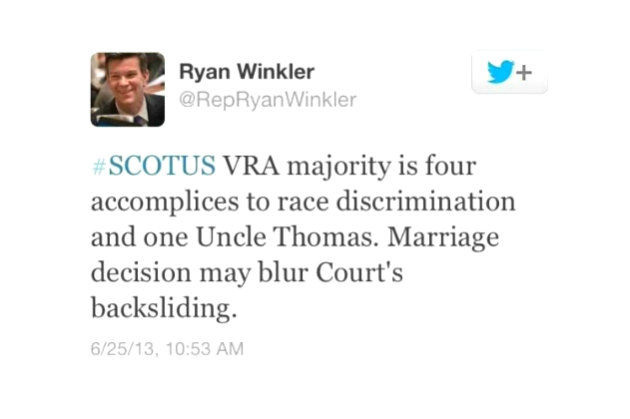
(Twitter via City Pages)

A Minnesota state representative has apologized for a tweet in which he referred to black Supreme Court Justice Clarence Thomas as "Uncle Thomas."

Shortly after the Supreme Court's 5-4 decision striking down a key provision of the Voting Rights Act was announced on Tuesday, Ryan Winkler, a Democratic lawmaker from Minnesota's 46th District, tweeted:

#SCOTUS VRA majority is four accomplices to race discrimination and one Uncle Thomas.

The tweet was subsequently deleted, and Winkler issued several apologies on Twitter, claiming he wasn't aware he had used a racial epithet.

"I did not understand 'Uncle Tom' as a racist term, and there seems to be some debate about it," Winkler wrote in response to a tweet linking to a blog post about his offensive message.

But there does not appear to be much debate. "Uncle Tom" refers to the faithful slave in Harriet Beecher Stowe's "Uncle Tom's Cabin" and is defined by Merriam-Webster as "a black who is overeager to win the approval of whites." Winkler's tweet suggested Thomas voted to gain the approval of his Caucasian counterparts.

"I didn't think it was offensive to suggest that Justice Thomas should be even more concerned about racial discrimination than colleagues," Winkler wrote on Twitter. "But if such a suggestion is offensive, I apologize."

According to Winkler's biography on the state House website, he earned a bachelor's degree in history at Harvard. He was elected in 2006.

In a statement posted to the site, Winkler added:

I was very disappointed today in the Supreme Court decision to roll back key provisions of the Voting Rights Act because I believe the Voting Rights Act is one of the most important steps our nation has taken to eliminate racial discrimination.

In expressing that disappointment on twitter, I hastily used a loaded term that is offensive to many. My words were inappropriate and I apologize. The implications of this Supreme Court decision are serious for our state and country and I regret that my comments have distracted from the serious dialogue we must have going forward to ensure racial discrimination has no place in our election system.

Winkler told Minnesota's Star Tribune he simply thought the epithet meant "turncoat."

"I intended to point out the fact that Justice Thomas had turned his back on African-American civil rights," Winkler said. "I did not intend it as a racially derogatory term and I probably reacted too hastily in using a word that is very loaded."

[Hat tip: Daily Intelligencer/City Pages]

Source: http://news.yahoo.com/blogs/news/clarence-thomas-uncle-tom-tweet-202207921.html

Hector Camacho Jill Kelly McKayla Maroney gronkowski jeremy renner best buy black friday deals breaking dawn part 2

23 Scouts hospitalized after lightning strike in Belmont, New Hampshire

By Ian Johnston, Staff Writer, NBC News

Twenty-three Boy Scouts were hospitalized after a lightning strike in New Hampshire on Monday night, a fire chief said.

Chief David Parenti, of Belmont Fire Station, said the Scouts, aged from 12 to 16, were at the Griswold Scout Reservation in Belmont when the incident happened.

He said they were taken to local hospitals for further evaluation.

When asked about their conditions, he said he ?wouldn't even call it serious.?

Parenti told NBC station WHDH that many of the injuries were minor burns. He said six scouts were given cardiac monitors because the burns were in the chest area.

However, he said this was done mostly as a precaution.

He told WHDH that the scouts had taken shelter under a tarp during the storm.

?At some point in time the lightning either struck nearby or struck the shelter they were under or a tree or something and traveled through into the meadow,? he said.

Greg Osborn, marketing director for Daniel Webster Council, a division of the Boy Scouts of America, said that three leaders were also affected by the strike.

He said no one was directly hit, but all reported a tingling sensation afterward.

Osborn said they were taken to Lakes Region Hospital and Concord Hospital as a precaution.

Related:

This story was originally published on

Source: http://feeds.nbcnews.com/c/35002/f/653381/s/2dc0a94d/l/0Lusnews0Bnbcnews0N0C0Inews0C20A130C0A60C250C191281210E230Escouts0Ehospitalized0Eafter0Elightning0Estrike0Ein0Ebelmont0Enew0Ehampshire0Dlite/story01.htm

jfk airport faith hill metro north taco bell taco bell Breezy Point Seaside Heights

Practical approach makes new ESC cardiac pacing and resynchronization guidelines accessible to all

Practical approach makes new ESC cardiac pacing and resynchronization guidelines accessible to all [ Back to EurekAlert! ] Public release date: 25-Jun-2013
[ | E-mail | Share Share ]

Contact: Jacqueline Partarrieu
press@escardio.org
33-492-947-756
European Society of Cardiology

Greater emphasis has been placed on a practical 'how to' approach targeted at generalists, including GPs and geriatricians, as well as expert cardiologists and electro physiologists

Athens-- The 2013 ESC Guidelines on Cardiac Pacing and Cardiac Resynchronization Therapy developed in collaboration with the European Heart Rhythm Association (EHRA), have created a new classification system for bradyarrhythmias according to mechanisms rather than aetiology. The guidelines, presented at the EHRA EUROPACE meeting 23-26 June in Athens, Greece, and published simultaneously in the European Heart Journal and Europace, have been redesigned to offer a more accessible format for users. Greater emphasis than ever before has been placed on a practical 'how to' approach targeted at generalists, including GPs and geriatricians, as well as expert cardiologists and electro physiologists.

"By taking this user friendly approach we hope to get our messages out to the wider medical community, which ultimately should allow more patients to benefit from the latest evidence-based medicine," explained Michele Brignole (Ospedali del Tigullio, Italy), Chairperson of the Guidelines on Cardiac Pacing and Cardiac Resynchronization Therapy Task Force.

The 2013 guidelines, revised for the first time since 2007, were developed with input from 70 clinicians, including an expert Task Force of 18 cardiologists specializing in cardiac pacing and resynchronization, a further 26 experts in the field who reviewed the document, with the entire process overseen by the ESC Committee for Practice Guidelines (CPG).

The first part of the guidelines explores indications for pacing in patients who have cardiac arrhythmias. The second part looks at indications for cardiac resynchronization therapy in heart failure. The third part includes indications for pacing in specific conditions, such as acute MI, pacing after cardiac surgery, TAVI and heart transplantation, and pacing in children and individuals with congenital heart diseases. Finally, the guidelines explore management considerations such as re implantation after device explanation for infection, magnetic resonance imaging in patients with implanted cardiac devices, emergency (transvenous) temporary pacing and remote management of arrhythmias and devices.

The new ESC Guidelines take into account whether the patient has a persistent problem, or whether it is intermittent, and whether it has been documented with electrocardiographic evidence (ECG documented) or not (ECG-undocumented). Until now, guidelines have classified bradyarrhythmias according to aetiology, for example whether the problem has been caused by sinus node dysfunction, myocardial infarction (MI), or bundle branch block. "One of the big innovations of these guidelines is the development of a logical decision tree displaying the different pacing modes according to different clinical situations. In effect these guidelines take the clinician by the hand and lead them through a series of three or four questions," explained Professor Perry Elliott (The Heart Hospital, London, UK) a member of the Guidelines committee.

With over 90 major studies on pacing and resynchronization published since the last guidelines, the Task Force went to considerable efforts to integrate the latest research. In areas where evidence is open to more than one interpretation, the guidelines provide information to help clinicians make a decision. For example, in patients with heart failure and poorly controlled symptoms, where choices have to be made between CRT pacemakers and CRT defibrillators, trials have had little to add to the decision making process. "Clinicians have to consider factors such as expected life expectancy and comorbidities when choosing between pacemaker and defibrillator therapy, said Prof Elliott.

These guidelines are the first ESC Guidelines ever to incorporate a new section called 'Clinical perspectives'. "This section gives advice on how to apply guidelines in real life clinical situations, taking into account things like what to do when patients have co morbidities or are taking concomitant drugs," explained Prof Brignole.

The abridged pocket version of the guidelines, due to be launched at the main ESC Congress in Amsterdam, 31st August to 4 September 2013, should further simplify the guidelines and make them accessible to an even wider audience.

###


[ Back to EurekAlert! ] [ | E-mail | Share Share ]

?


AAAS and EurekAlert! are not responsible for the accuracy of news releases posted to EurekAlert! by contributing institutions or for the use of any information through the EurekAlert! system.


Practical approach makes new ESC cardiac pacing and resynchronization guidelines accessible to all [ Back to EurekAlert! ] Public release date: 25-Jun-2013
[ | E-mail | Share Share ]

Contact: Jacqueline Partarrieu
press@escardio.org
33-492-947-756
European Society of Cardiology

Greater emphasis has been placed on a practical 'how to' approach targeted at generalists, including GPs and geriatricians, as well as expert cardiologists and electro physiologists

Athens-- The 2013 ESC Guidelines on Cardiac Pacing and Cardiac Resynchronization Therapy developed in collaboration with the European Heart Rhythm Association (EHRA), have created a new classification system for bradyarrhythmias according to mechanisms rather than aetiology. The guidelines, presented at the EHRA EUROPACE meeting 23-26 June in Athens, Greece, and published simultaneously in the European Heart Journal and Europace, have been redesigned to offer a more accessible format for users. Greater emphasis than ever before has been placed on a practical 'how to' approach targeted at generalists, including GPs and geriatricians, as well as expert cardiologists and electro physiologists.

"By taking this user friendly approach we hope to get our messages out to the wider medical community, which ultimately should allow more patients to benefit from the latest evidence-based medicine," explained Michele Brignole (Ospedali del Tigullio, Italy), Chairperson of the Guidelines on Cardiac Pacing and Cardiac Resynchronization Therapy Task Force.

The 2013 guidelines, revised for the first time since 2007, were developed with input from 70 clinicians, including an expert Task Force of 18 cardiologists specializing in cardiac pacing and resynchronization, a further 26 experts in the field who reviewed the document, with the entire process overseen by the ESC Committee for Practice Guidelines (CPG).

The first part of the guidelines explores indications for pacing in patients who have cardiac arrhythmias. The second part looks at indications for cardiac resynchronization therapy in heart failure. The third part includes indications for pacing in specific conditions, such as acute MI, pacing after cardiac surgery, TAVI and heart transplantation, and pacing in children and individuals with congenital heart diseases. Finally, the guidelines explore management considerations such as re implantation after device explanation for infection, magnetic resonance imaging in patients with implanted cardiac devices, emergency (transvenous) temporary pacing and remote management of arrhythmias and devices.

The new ESC Guidelines take into account whether the patient has a persistent problem, or whether it is intermittent, and whether it has been documented with electrocardiographic evidence (ECG documented) or not (ECG-undocumented). Until now, guidelines have classified bradyarrhythmias according to aetiology, for example whether the problem has been caused by sinus node dysfunction, myocardial infarction (MI), or bundle branch block. "One of the big innovations of these guidelines is the development of a logical decision tree displaying the different pacing modes according to different clinical situations. In effect these guidelines take the clinician by the hand and lead them through a series of three or four questions," explained Professor Perry Elliott (The Heart Hospital, London, UK) a member of the Guidelines committee.

With over 90 major studies on pacing and resynchronization published since the last guidelines, the Task Force went to considerable efforts to integrate the latest research. In areas where evidence is open to more than one interpretation, the guidelines provide information to help clinicians make a decision. For example, in patients with heart failure and poorly controlled symptoms, where choices have to be made between CRT pacemakers and CRT defibrillators, trials have had little to add to the decision making process. "Clinicians have to consider factors such as expected life expectancy and comorbidities when choosing between pacemaker and defibrillator therapy, said Prof Elliott.

These guidelines are the first ESC Guidelines ever to incorporate a new section called 'Clinical perspectives'. "This section gives advice on how to apply guidelines in real life clinical situations, taking into account things like what to do when patients have co morbidities or are taking concomitant drugs," explained Prof Brignole.

The abridged pocket version of the guidelines, due to be launched at the main ESC Congress in Amsterdam, 31st August to 4 September 2013, should further simplify the guidelines and make them accessible to an even wider audience.

###


[ Back to EurekAlert! ] [ | E-mail | Share Share ]

?


AAAS and EurekAlert! are not responsible for the accuracy of news releases posted to EurekAlert! by contributing institutions or for the use of any information through the EurekAlert! system.


Source: http://www.eurekalert.org/pub_releases/2013-06/esoc-pam062013.php

Gangster Squad school shooting oscar nominations C7 Corvette tom brady denver post Scandal

Microsoft confirms Internet Explorer 11 is coming to Windows 7

Microsoft confirms Internet Explorer 11 will receive Windows 7 support

With Windows 8.1, Microsoft has pushed out a revamped version of Internet Explorer that is supposed to be significantly faster than its predecessor, not to mention the fact that it claims to be easier on battery life. Fortunately, it appears that the company fully intends to make IE11 available to Windows 7 users as well. While Microsoft opened up about this fact, it wasn't so keen to offer up any timing expectations. Thus, it's quite possible that we may not see it show up on Win7 until after it's had some time to bedazzle those who are already packing the latest and greatest version of Windows.

Filed under: , , ,

Comments

Source: http://www.engadget.com/2013/06/26/microsoft-internet-explorer-11/?utm_medium=feed&utm_source=Feed_Classic&utm_campaign=Engadget

alex rodriguez Netflix down paul george Warm Bodies Mexico vs Jamaica Jiah Khan Teen Wolf

Filibuster broken, but Texas abortion law fails to pass

Filibuster fails: Wendy Davis spoke for 11 hours in a filibuster but was stopped before the midnight deadline. Still, the Texas abortion law failed to pass when protestors managed to stall a vote.

By Chris Thomlinson and Jim Vertuno,?Associated Press / June 26, 2013

Texas State Sen. Wendy Davis (D) of Fort Worth, waits for a ruling on a rules violation during her filibusters of an abortion bill, Tuesday, June 25, in Austin, Texas. Senator Davis was given a second warning for breaking filibuster rules by receiving help with a back brace from Sen. Rodney Ellis (D) of Houston.

Eric Gay/AP

Enlarge

Despite barely beating a midnight deadline, hundreds of jeering protesters helped stop Texas lawmakers from passing one of the toughest abortion measures in the country.

Skip to next paragraph

' + google_ads[0].line2 + '
' + google_ads[0].line3 + '

'; } else if (google_ads.length > 1) { ad_unit += ''; } } document.getElementById("ad_unit").innerHTML += ad_unit; google_adnum += google_ads.length; return; } var google_adnum = 0; google_ad_client = "pub-6743622525202572"; google_ad_output = 'js'; google_max_num_ads = '1'; google_feedback = "on"; google_ad_type = "text"; // google_adtest = "on"; google_image_size = '230x105'; google_skip = '0'; // -->

As the protesters raised the noise to deafening levels in the Texas Senate chamber late Tuesday, Republicans scrambled to gather their colleagues at the podium for a stroke-of-midnight vote.

"Get them out!" Sen. Donna Campbell shouted to a security guard, pointing to the thundering crowd in the gallery overhead that had already been screaming for more than 10 minutes.

"Time is running out," Campbell pleaded. "I want them out of here!"

It didn't work. The noise never stopped and despite barely beating the midnight end-of-session deadline with a vote to pass the bill, Lt. Gov. David Dewhurst said the chaos in the chamber prevented him from formally signing it before the deadline passed, effectively killing it.

Dewhurst denounced the protesters as an "unruly mob." Democrats who urged them on called the outburst democracy in action.

In either point of view, a raucous crowd of chanting, singing, shouting demonstrators effectively took over the Texas Capitol and blocked a bill that abortion rights groups warned would close most abortion clinics in the state.

"They were asking for their voices to be heard," said Sen. Wendy Davis of Fort Worth, who spent nearly 11 hours trying to filibuster the bill before the outburst. "The results speak for themselves."

The final outcome took several hours to sort out.

Initially, Republicans insisted the vote started before the midnight deadline and passed the bill that Democrats spent the day trying to kill. But after official computer records and printouts of the voting record showed the vote took place Wednesday, and then were changed to read Tuesday, senators retreated into a private meeting to reach a conclusion.

At 3 a.m., Dewhurst emerged from the meeting still insisting the 19-10 vote was in time, but said, "with all the ruckus and noise going on, I couldn't sign the bill" and declared it dead.

He denounced the more than 400 protesters who staged what they called "a people's filibuster" from 11:45 p.m. to well past midnight. He denied mishandling the debate.

"I didn't lose control (of the chamber). We had an unruly mob," Dewhurst said. He even hinted that Gov. Rick Perry may immediately call another 30-day special session, adding: "It's over. It's been fun. But see you soon."

Many of the protesters had flocked to the normally quiet Capitol to support Davis, who gained national attention and a mention from President Barack Obama's campaign Twitter account. Her Twitter following went from 1,200 in the morning to more than 20,000 by Tuesday night.

"My back hurts. I don't have a lot of words left," Davis said when it was over and she was showered with cheers by activists who stayed at the Capitol to see her. "It shows the determination and spirit of Texas women."

Source: http://rss.csmonitor.com/~r/feeds/csm/~3/evm4XPr2xMU/Filibuster-broken-but-Texas-abortion-law-fails-to-pass

pangolin Ball Bearings Macklemore irs forms kevin hart oklahoma city bombing Audrie Pott

Supreme Court halts use of key part of voting law

WASHINGTON (AP) ? A deeply divided Supreme Court threw out the most powerful part of the landmark Voting Rights Act on Tuesday, a decision deplored by the White House but cheered by mostly Southern states now free from nearly 50 years of intense federal oversight of their elections.

Split along ideological and partisan lines, the justices voted 5-4 to strip the government of its most potent tool to stop voting bias ? the requirement in the Voting Rights Act that all or parts of 15 states with a history of discrimination in voting, mainly in the South, get Washington's approval before changing the way they hold elections.

Chief Justice John Roberts, writing for a majority of conservative, Republican-appointed justices, said the law's provision that determines which states are covered is unconstitutional because it relies on 40-year-old data and does not account for racial progress and other changes in U.S. society.

The decision effectively puts an end to the advance approval requirement that has been used to open up polling places to minority voters in the nearly half century since it was first enacted in 1965, unless Congress can come up with a new formula that Roberts said meets "current conditions" in the United States. That seems unlikely to happen any time soon.

President Barack Obama, the nation's first black chief executive, issued a statement saying he was "deeply disappointed" with the ruling and calling on Congress to update the law.

But in the South, Alabama Gov. Robert Bentley said that, while the requirement was necessary in the 1960s, that was no longer the case. He said, "We have long lived up to what happened then, and we have made sure it's not going to happen again."

The advance approval, or preclearance, requirement shifted the legal burden and required governments that were covered to demonstrate that their proposed election changes would not discriminate.

Going forward, the outcome alters the calculus of passing election-related legislation in the affected states and local jurisdictions. The threat of an objection from Washington has hung over such proposals for nearly a half century. Unless Congress acts, that deterrent now is gone.

That prospect has upset civil rights groups which especially worry that changes on the local level might not get the same scrutiny as the actions of state legislatures.

Tuesday's decision means that a host of state and local laws that have not received Justice Department approval or have not yet been submitted can take effect. Prominent among those are voter identification laws in Alabama and Mississippi.

Texas Attorney General Greg Abbott, a Republican, said his state's voter ID law, which a panel of federal judges blocked as discriminatory, also would be allowed to take effect.

Justice Ruth Bader Ginsburg, dissenting from the ruling along with the court's three other liberal, Democratic appointees, said there was no mistaking the court's action.

"Hubris is a fit word for today's demolition" of the law, she said.

Reaction to the ruling from elected officials generally divided along partisan lines.

Mississippi Lt. Gov. Tate Reeves, a Republican, said in a news release, "The practice of preclearance unfairly applied to certain states should be eliminated in recognition of the progress Mississippi has made over the past 48 years."

But Democratic Rep. Bennie Thompson, the only black lawmaker in Mississippi's congressional delegation, said the ruling "guts the most critical portion of the most important civil rights legislation of our time."

Alabama Gov. Bentley, a Republican, pointed to his state's legislature ? 27 percent black, similar to Alabama's overall population ? as a sign of the state's progress.

The court challenge came from Shelby County, Ala., a Birmingham suburb.

The prior approval requirement had applied to the states of Alabama, Alaska, Arizona, Georgia, Louisiana, Mississippi, South Carolina, Texas and Virginia. It also covered certain counties in California, Florida, New York, North Carolina and South Dakota, and some local jurisdictions in Michigan. Coverage was triggered by past discrimination not only against blacks, but also against American Indians, Asian-Americans, Alaska Natives and Hispanics.

Obama, whose historic election was a subtext in the court's consideration of the case, pledged that his administration would continue to fight discrimination in voting. "While today's decision is a setback, it doesn't represent the end of our efforts to end voting discrimination," the president said. "I am calling on Congress to pass legislation to ensure every American has equal access to the polls."

Congress essentially ignored the court's threat to upend the voting rights law in a similar case four years ago. Roberts said the "failure to act leaves us today with no choice."

Congressional Democrats said they are eager to make changes, but Republicans were largely noncommittal.

Sen. Charles Schumer, D-N.Y., said he expects Republicans to block efforts to revive the law, even though a Republican-led Congress overwhelmingly approved its latest renewal in 2006 and President George W. Bush signed it into law.

"As long as Republicans have a majority in the House and Democrats don't have 60 votes in the Senate, there will be no preclearance. It is confounding that after decades of progress on voting rights, which have become part of the American fabric, the Supreme Court would tear it asunder," Schumer said.

Attorney General Eric Holder said the Justice Department "will not hesitate to take swift enforcement action, using every legal tool that remains available to us, against any jurisdiction that seeks to take advantage of the Supreme Court's ruling by hindering eligible citizens' full and free exercise of the franchise."

Those federal tools include other permanent provisions of the Voting Rights Act that prohibit discrimination and apply nationwide. But they place the burden of proof on the government and can be used only one case at a time.

The Obama administration and civil rights groups said there is a continuing need for the federal law and pointed to the Justice Department's efforts to block voter ID laws in South Carolina and Texas last year, as well as a redistricting plan in Texas that a federal court found discriminated against the state's large and growing Hispanic population.

The justices all agreed that discrimination in voting still exists.

But Roberts said that the covered states have largely eradicated the problems that caused them to be included in the first place.

"The coverage formula that Congress reauthorized in 2006 ignores these developments, keeping the focus on decades-old data relevant to decades-old problems, rather than current data reflecting current needs," the chief justice said.

Ginsburg countered that Congress had found that the prior approval provision was necessary "to prevent a return to old ways."

Instead, "the court today terminates the remedy that proved to be best suited to block that discrimination," she said in a dissent that she read aloud in the packed courtroom.

Ginsburg said the law continues to be necessary to protect against what she called subtler, "second-generation" barriers to voting. She identified one such effort as the switch to at-large voting from a district-by-district approach in a city with a sizable black minority. The at-large system allows the majority to "control the election of each city council member, effectively eliminating the potency of the minority's votes," she said.

Justice Clarence Thomas was part of the majority, but wrote separately to say anew that he would have struck down the advance approval requirement itself.

Civil rights lawyers condemned the ruling.

"The Supreme Court has effectively gutted one of the nation's most important and effective civil rights laws. Minority voters in places with a record of discrimination are now at greater risk of being disenfranchised than they have been in decades," said Jon Greenbaum, chief counsel for the Lawyers' Committee for Civil Rights Under Law.

The decision comes five months after Obama started his second term in the White House, re-elected by a diverse coalition of voters.

The high court is in the midst of a broad re-examination of the ongoing necessity of laws and programs aimed at giving racial minorities access to major areas of American life from which they once were excluded. The justices issued a modest ruling Monday that preserved affirmative action in higher education and will take on cases dealing with anti-discrimination sections of a federal housing law and another affirmative action case from Michigan next term.

The Alabama county's lawsuit acknowledged that the measure's strong medicine was appropriate and necessary to counteract decades of state-sponsored discrimination in voting, despite the Fifteenth Amendment's guarantee of the vote for black Americans.

But it asked whether there was any end in sight for a provision that intrudes on states' rights to conduct elections and was considered an emergency response when first enacted in 1965.

The county noted that the 25-year extension approved in 2006 would keep some places under Washington's oversight until 2031. And, the county said, it seemed not to account for changes that include the elimination of racial disparity in voter registration and turnout or the existence of allegations of race-based discrimination in voting in areas of the country that are not subject to the provision.

___

Associated Press writers Emily Wagster Pettus in Jackson, Miss., and Bob Johnson in Montgomery, Ala. contributed to this report.

Source: http://news.yahoo.com/supreme-court-halts-key-part-voting-law-200525381.html

Veterans Day 2012 Nate Silver Obama Acceptance Speech 2012 dow jones Selena Gomez ariel winter Paige Butcher